

ADDRESS BY CHIEF CHEKWAS OKORIE AT THE INAUGURAL MEETING OF IGBO AGENDA DIALOGUE (IAD) AT CHELSEA HOTEL ABUJA ON WEDNESDAY 27TH AUGUST 2025
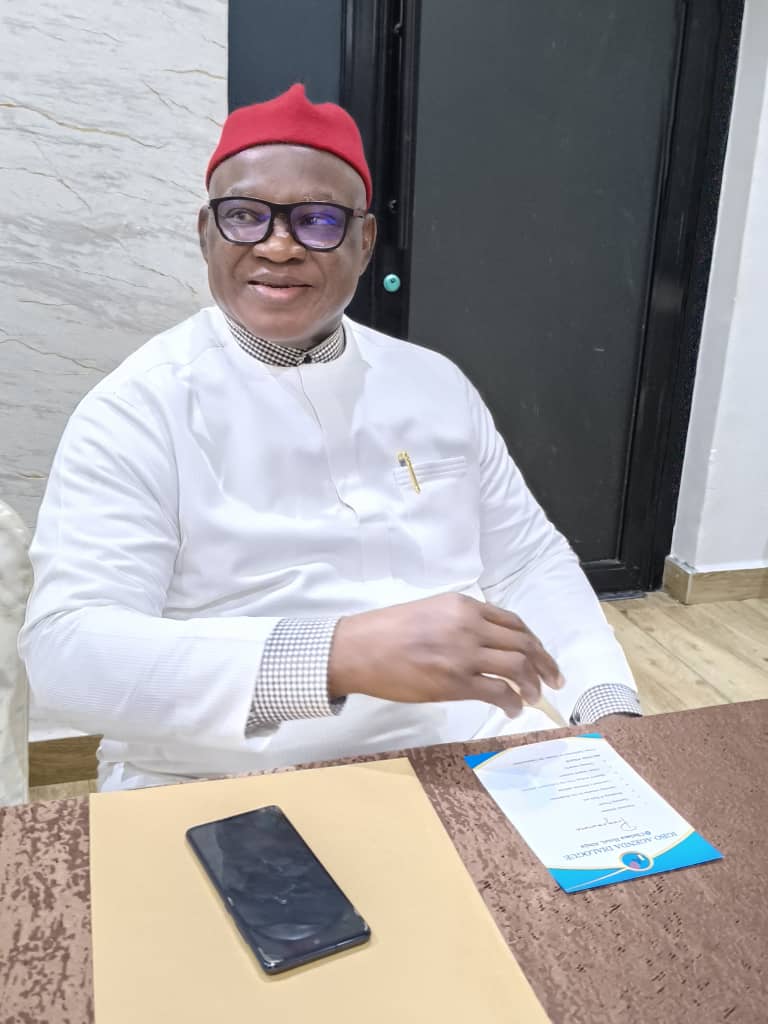
Fellow Compatriots,
It is with great joy that I welcome you to this historic meeting. The purpose of convening this meeting has been hinted in the letter of invitation each of you received.
There is no doubt in my mind that many of us including those who are not here have at various times reflected on the need for the Igbo Nation to formulate a political agenda for our people in Nigeria that will be a template for our political
engagement in our country, Nigeria, irrespective of political affiliations.
I am certain that the fear of the suspicion of ulterior motives and other similar insinuations must have played some roles in making some of our well meaning political leaders to hold back. But the time has come when holding back from calling our leaders together to join hands to salvage our people who can no longer wait simply because of the fear of the unknown.
I wish to state unequivocally at the onset that the Igbo Agenda Dialogue, IAD, is not a parallel organization to Ohanaeze Ndigbo Worldwide, which remains and must be respected as the apex pan Igbo socio-cultural
organization.
Invitation to this meeting was limited in number but carefully selected to cut across political Party lines, leaders of Market and Professional Associations, Town Unions and other critical stakeholders.
The success of this meeting is intended to lead us to a convocation of Igbo Political Summit which will hold at Enugu on a date to be agreed on. The scope of such Political Summit is expected to be inclusive and comprehensive.
The target audience will include the Igbo People; the indigenous Igbo People of Edo, Delta, Kogi, Benue, Cross River,
Akwa Ibom, Bayelsa, Rivers States, and the five States of the South East geo-political zone.
The leaders of all the identified Market Associations, Town Unions, Professional bodies, Igbo in Diaspora Associations, Women and Youth Associations and individual stakeholders of remarkable accomplishments.
We expect that such a comprehensive and all inclusive gathering of Igbo leaders will in one accord adopt the Igbo Charter which a select group of our knowledgeable and experienced sons and daughters that will later be appointed will put heads together to articulate the documents which must be
of such quality and depth that will stand the test of time.
It is on record that the Igbo people of Nigeria have not held any political summit or developed a generally acceptable political agenda in Nigeria since 1970 when the Nigeria - Biafra war ended officially.
Unfortunately, our lack of cohesion and unity of purpose has exposed us to very embarrassing ridicule, disrespect, alienation and marginalisation by our contemporaries who have managed to be in control of the lever of political power and commanding heights of Nigerian economy and bureaucracy. Things came to a most worrisome head when a former president of Nigeria
while presiding over the affairs of the country described us as a dot in a circle, which in a sense implies that we are landlocked. The true position as is well known even by the person that mocked us in that manner is that there is no ethnic nationality in Nigeria that has greater access to the sea than the Igbo Nation.
Following the advent of the Igbo Forum in 1976, which metamorphosed into Ohanaeze Ndigbo in 1979, Dr. Nnamdi Azikiwe, who was our patron then, repeatedly cautioned during our meetings that the worst thing that usually happened to any race that lost a war was the loss of self-esteem. He further said that it would take several decades of conscientious focused
leadership to recover from the loss of self-esteem. I remember those inimitable words when I watched with sadness and embarrassment the sycophantic, subservient, and condescending posturing of some of our leaders just to get by in a country where we are supposed to be equal stakeholders. Some even disown their identities as Igbo to escape oppression by those in power. It is now 55 years since the Biafra/Nigeria fratricidal war ended. Now is the time to redeem, reassert, and reclaim our inalienable rights in Nigeria.
We are unarguably the ethnic nationality with the largest population in Nigeria. Our geographical spread in this vast country is second to none. We are easily
the second largest population of practically all the states of Nigeria and about 99% of the population of the South East geo-political zone.
Similarly, studies have proved that we constitute a minimum of the 25% of the voting population of all the States of Nigeria including the Federal Capital Territory.
In view of the nature of democratic practice in Nigeria, the majority of votes and its component geographical spread are the critical factors that determine electoral victory in our elections. It stands to reason that if we put our acts together that nobody will win a presidential election in Nigeria without sitting with Igbo to agree on the terms
of engagement.
Some of us who witnessed and can recollect the various democratic dispensations in Nigeria from the First Republic to the present time will agree without argument that Ndigbo were better off in the First and Second Republics when the then Northern Peoples Congress (NPC) and the National Council of Nigerian Citizens (NCNC) formed a coalition government, and the National Party of Nigeria (NPN) and Nigerian Peoples Party (NPP) formed an accord (another form of a coalition government). In fact, in the Second Republic, an Igbo man was the Vice President, Dr Alex Ekwueme of the NPN, and another Igbo man, Chief Edwin Umezuoke of the NPP was the Speaker
of the House of Representatives as a result of that accord. That combination has not been replicated since that time. It could also be recalled that the coalition of the NPC - NCNC facilitated the creation of the Midwestern Region in spite of the vehement opposition of the Action Group (AG).
Permit me to cite yet another interesting example of what Igbo political unity can achieve and juxtapose it with what our lack of participation can deny us.
In the 2011 presidential election, it is in the record of INEC that the South East delivered more than seven million votes to President Goodluck Ebele Jonathan. That was the highest votes President Jonathan scored in the six geo-political
zones of the country and won the election. In the build up to the 2015 presidential election, Igbo leaders were disappointed that there was no Federal presence in the South East geo-political zone. Ohanaeze leaders quietly sent a delegation led by Dr Alex Ekwueme to President Jonathan to register the disappointment of Ndigbo. The Ekwueme-led team came back with the report that he would not turn back the hand of the clock but would require our support for his re-election that it was then he would correct what he referred to as oversight.
Ndigbo were not satisfied with that response. In the 2015 presidential election most Igbo voters voted on their backside. In other words, they did not
vote for him neither did they vote for his main opponent, General Muhammadu Buhari. At the end of the ballot, President Jonathan got a little more than three million votes in the same area that gave him seven million votes. He lost that election to General Buhari by 2.5 million votes. This is a clear indication that the votes from the South East would have made the difference and returned him to power if he did not take our support for granted.
Let us fast forward to 2023 presidential election. By this time Igbo interest in elections in Nigeria had waned considerably. Our son, Peter Obi took up the presidential flag of the Labour Party and triggered a movement that took the Nigerian political scene by storm. At the
end of the election, Peter Obi won 88% of the total votes cast in the South East. Asiwaju Bola Ahmed Tinubu won 5.1% of the votes, while the former Vice President Atiku Abubakar won 4.7% of the votes. The downside of the seemingly excellent performance of Peter Obi in the South East is that the figure credited to him amounted to 1.8 million less than one-third the South East delivered to President Jonathan in 2011. That shows the depth of despondency and lack of interest of Igbo people in participating in Nigeria's politics.
This situation cannot continue. We have a collective responsibility to reawaken the sleeping giants in a deliberate, consistent and persuasive manner. To
avoid taking Igbo votes for granted, we shall insist on an acceptable Memorandum of Understanding (MoU) for whoever we shall support for presidential election in Nigeria and make sure the MoU can be found in all our verified social media handles including website for Igbo people to know that their votes can never be taken for granted again. We will encourage Ndigbo in all the States of the Federation and Local Governments in which they have the numerical strength that will take care of their special circumstance before they will lend their votes to any candidates vying for any office where they are domiciled.
We shall take steps to wheel the well established Igbo network that already
exists through their various Associations and Unions into a formidable Igbo National Grid. We will take deliberate steps to bring all known and credible Igbo Associations all over the world in to the grid.
This is by all means a very ambitious project but it is doable. We will take steps to educate and persuade our young men and women to know that the Permanent Voters Card (PVC) which they are entitled to for no cost is by far more potent than any AK 47 rifle in securing our freedom, liberty, self-determination and relevance in Nigeria without firing a shot and without shedding any person's blood.
My father told me repeatedly during my
teenage years that if you are not loved, you should at least be feared. That somebody would do something for you because he loved you or he would be afraid of how you would react if you were denied your right.
In the case of a race, like the Igbo race, while you cannot force anybody to love you but you can earn the respect of others; the aura Igbo people are known for which elicit both fear and respect. Any race that is neither loved nor respected is not worth its name.
It is generally said that heaven helps those who help themselves. In the case of Ndigbo in Nigeria, God has already blessed us with huge population, geographical spread and unrivalled
human resources. We are the ones holding ourselves back. We can resolve today that starting from few us in this hall, we can join hands to redeem ourselves and live to witness the inevitable resurgence of Ndigbo to assume their rightful place in Nigeria's political space.
Thank you and God bless you.